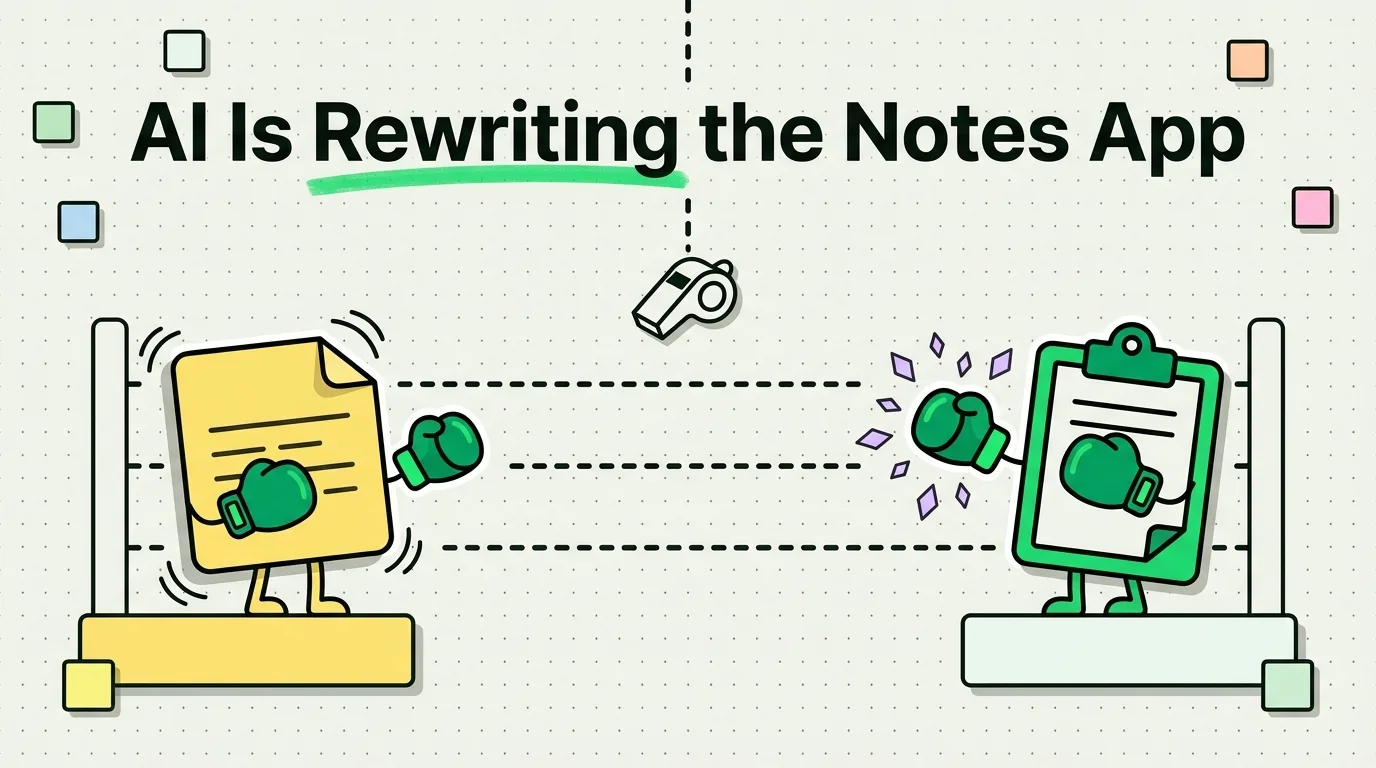
AI isn't replacing your notes app by making it smarter. It's replacing it by making a completely different tool - the clipboard manager - so automatic and so intelligent that the notes app's core job (capturing information) becomes unnecessary. The shift is already underway. Smart clipboard managers like ClipboardAI now auto-categorize everything you copy: phone numbers, links, email addresses, OTP codes, and freeform text - all sorted the instant you copy, with no manual filing whatsoever.
If you're still opening Notes every time you want to save something, you're doing it the hard way.
Why the Notes App Fails at Capture
Here's a workflow you've done hundreds of times: You see a phone number in a text message. You think "I should save that." So you open Notes, tap the plus button, create a new note, paste the number, try to think of a title - and either give it a title so vague it's useless ("phone"), or leave it untitled and lose it in a sea of untitled notes.
That friction is the real problem. Not the app itself. Apple Notes is actually excellent at what it's designed for: long-form writing, document scanning, collaborative editing, rich content. It's a workshop, not a capture net.
But the capture phase - grabbing information from the stream of your daily life - requires something that works at clipboard speed. Zero taps. Zero friction. Zero decision-making.
That's what AI-powered clipboard management does.
How AI Clipboard Management Actually Works
When you copy anything on your iPhone, it hits the system clipboard (technically called the UIPasteboard). Normally, that clipboard holds exactly one item and gets overwritten the moment you copy something new. ClipboardAI intercepts that stream - legally, using iOS's background monitoring capability - and saves each item to a local database on your device.
But saving isn't the interesting part. Categorization is.
Using pattern recognition and lightweight on-device AI models, ClipboardAI identifies what type of content you copied:
- A 10-digit string with dashes → Phone Number category
- A URL starting with
https://→ Links category - A string matching email format → Email Addresses category
- A 6-digit numeric code that arrives right after an SMS → OTP/Codes category
- Everything else → Text category
No manual tagging. No "add to folder" prompt. You copy; it categorizes. The result is a running, organized inbox of everything that's flowed through your clipboard today - searchable, browsable, and accessible from your keyboard without switching apps.
The Three AI Features That Make Clipboard Managers Genuinely Useful
1. Smart Categorization
This is live, today. Copy a tracking number from an Amazon email; it files under Codes. Copy a restaurant's address from Maps; it files under Addresses. The categorization happens in under a second.
The practical benefit: instead of "where did I copy that link?" you tap Links and scan your last dozen. It's usually the third item down.
2. Semantic Search (Coming Soon, Partly Here Now)
Traditional clipboard search is keyword-only - you need to remember the exact text you copied. Semantic search understands meaning. Searching "Amazon order" should surface your tracking number even if the copied text was "Order #112-4782901-2847234 from Amazon.com."
This is the next frontier for clipboard AI. Some apps are already integrating vector search into clipboard history. The experience of typing a rough description and finding the clip you need - even if you copied it three days ago - is genuinely different.
3. Predictive Pasting
This one is still mostly speculative, but the building blocks exist. Your clipboard manager knows what app you're in, what you've typed so far, and what's in your history. A smart enough system could suggest "You're in the Booking.com checkout - here's the credit card number you copied two minutes ago." No digging. Just a suggestion.
What This Means for Notes Apps
Notes apps aren't going away. They're changing jobs.
Think of it this way: a clipboard manager is your automatic inbox - it catches everything without you having to think. A notes app is your workspace - where you process, develop, and store what you decide matters.
The two-layer workflow that actually works:
- ClipboardAI captures everything as you work - links, codes, addresses, snippets.
- Apple Notes receives the important stuff - when something from your clipboard history is worth keeping long-term, you copy it and paste it into a properly organized note.
Notes stays clean because you only put things there deliberately. Your clipboard history handles the ambient information you need today. Neither tool tries to do both jobs.
The Snippet Kit: What to Keep Pinned in Your Clipboard Manager
Beyond automatic capture, the other high-value use of a clipboard manager is a library of pinned snippets - text you type over and over that you never want to retype. Here's a starter kit:
=== Frequently Used Snippets ===

[Your Email]
your@email.com

[Your Phone]
+1 (555) 000-0000

[Mailing Address]
123 Main Street, City, State 00000

[Zoom Personal Link]
https://zoom.us/j/YOUR_MEETING_ID

[LinkedIn Profile]
https://linkedin.com/in/yourhandle

[Standard Email Sign-off]
Thanks,
[Your Name]
[Title] | [Company]
[Phone] | [Email]
These stay pinned regardless of what else you copy. Every time you need your email address in a form, your address for a delivery, or your Zoom link for a calendar invite - one tap from the keyboard extension.
Honest Caveats
- ClipboardAI does not store passwords (and shouldn't - see the privacy warning below). If your password manager copies a password to the clipboard, configure your clipboard manager to ignore items from password manager bundle IDs.
- Clipboard history isn't a research tool. It captures what you copy, not what you read. For collecting research notes or writing long-form thoughts, you still want Notes or Notion.
- Older devices may notice a battery impact from background clipboard monitoring. On iPhone 14 and later, the impact is negligible.
⚠️ Privacy Warning: Never copy passwords, Social Security numbers, bank account numbers, or medical identifiers and leave them in clipboard history. If you accidentally copy sensitive data, open ClipboardAI and swipe to delete that item immediately. On Mac, ClipboardAI automatically skips anything copied from apps like 1Password, KeePassXC, or BetterTouchTool (no setup needed), and you can add any other app to the "Excluded Apps" list in Settings so nothing copied while it's frontmost gets saved. This exclusion feature is Mac-only; iOS has no equivalent setting.
The Shift Has Already Happened
Automatic capture, smart categorization, keyboard-accessible history - these aren't predictions. They exist in ClipboardAI right now, on your iPhone. The notes app as information-dump is already obsolete. The question isn't whether you'll change your workflow, it's whether you'll do it intentionally or keep losing things to the one-clipboard-item-at-a-time limitation of iOS.
Copy something. Let the AI sort it. Find it later without thinking. That's the workflow. And once you use it for a week, going back to Notes-as-clipboard feels like going back to paper maps.