
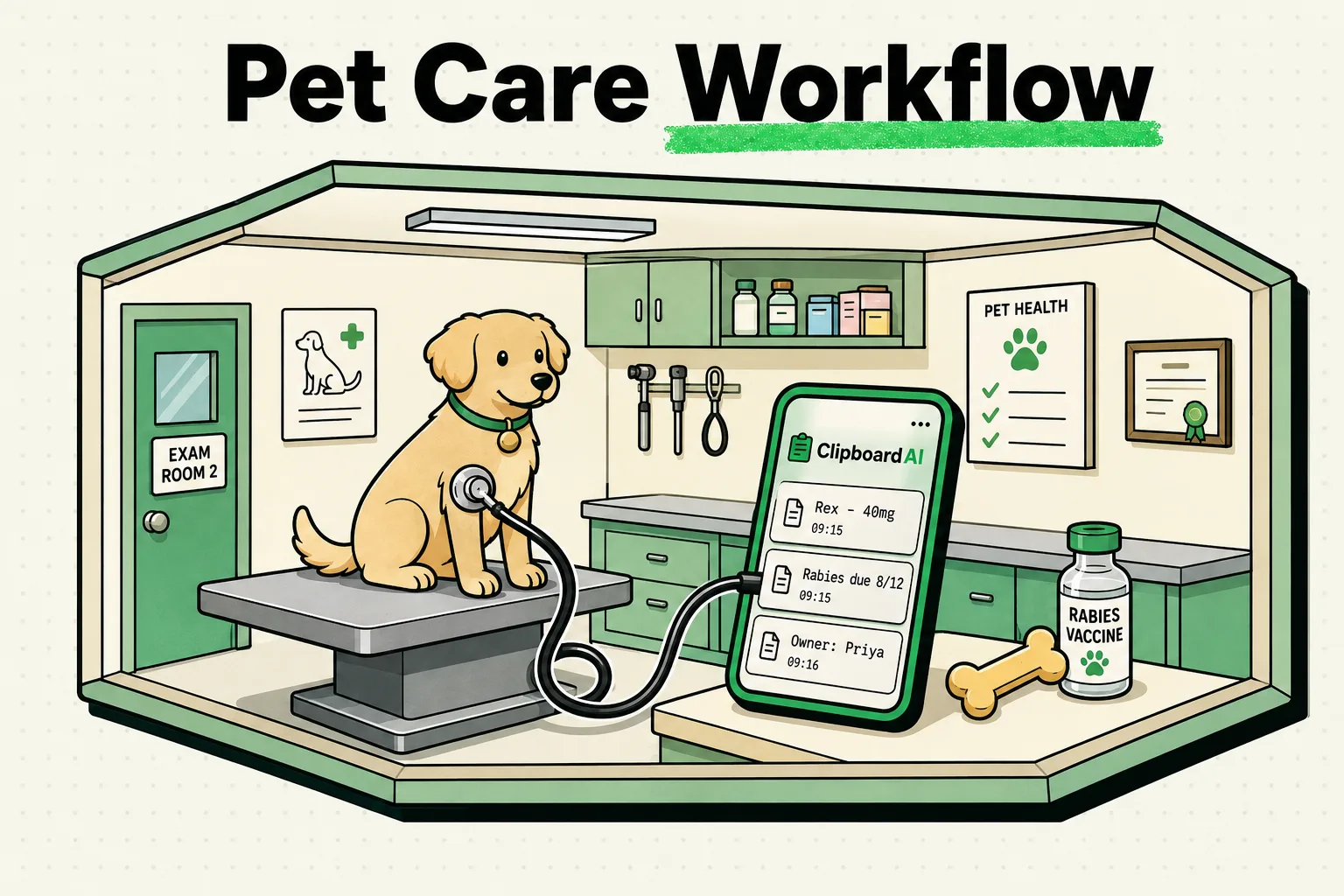
Veterinarians manage complex patient details daily: medication dosages, vaccine schedules, pet microchip IDs, owner contact numbers, and lab results. A clipboard manager for veterinarians stores these critical records in a searchable, organized database on your computer or mobile device. By keeping a running history of your copied items, tools like ClipboardAI prevent you from losing patient weight details when you copy an owner's phone number, reducing transcription errors between practice management software and pharmacy logs.
In a busy veterinary clinic, your attention is divided between active clinical procedures and the paperwork that follows them. If you are copying a 15-digit microchip number from a scanner portal or a lab report and trying to paste it into a patient’s medical record, only to have it overwritten by the owner's billing address, you have to spend time searching for that number again. Worse, manual transcription errors can lead to medication dosage mistakes or mislabeled records. A dedicated clipboard manager keeps this vital data accurate and instantly accessible. In this guide, we will look at how to build a secure clipboard workflow for veterinary practice.
Reducing Errors in Veterinary Documentation
A veterinarian's documentation must be precise. When prescribing medications or sending lab results, copying and pasting data directly is much safer than re-typing.
Consider a typical patient discharge process:
- You copy the pet's updated weight (
18.4 kg) from their chart. - You paste it into the dosage calculator to determine the medication volume.
- You need to copy the prescription instructions ("Give 1 tablet every 12 hours with food") to send to the pharmacy queue.
- You press copy. The patient weight is now deleted from your clipboard.
- If you need to double-check the dose calculation for the patient’s record later, you have to go back to the chart, re-find the weight, and copy it again.
By preserving your clipboard history, you can copy the pet's weight, their microchip number, the owner's email, and the medication instructions in one go, then paste them into the appropriate fields in your practice management system (like CornerStone, Neo, or Covetrus) without jumping between windows.
Required Value Artifact: The Vet Clinic's Patient Discharge & Spec Kit
We have built a template kit of standard patient discharge summaries, pharmacy communication formats, and quick-reference calculators. Save these directly to your pinned items in ClipboardAI to keep your documentation consistent and fast.
1. Patient Discharge Instructions Template
Copy and pin this block to quickly build discharge sheets for pet owners:
### 🐾 Patient Discharge Notes
- **Patient Name & Species:** [Pet Name] ([Dog/Cat/Other])
- **Primary Clinician:** Dr. [Last Name]
- **Reason for Visit:** [e.g., Routine Dental Clean / Spay]
- **Medications Prescribed:**
  - **Medication:** [Name] ([Dosage, e.g., 50mg])
  - **Instructions:** [e.g., 1 tablet orally every 12 hours for 5 days]
- **Care Instructions:**
  - [ ] Restrict activity for [Number] days (no running or jumping).
  - [ ] Monitor incision site daily for swelling or redness.
  - [ ] Offer small amounts of water/food tonight; return to normal diet tomorrow.
- **Follow-Up Appointment:** [Date] @ [Time]
2. Standard Pharmacy Order Format
Keep this format pinned for quick copy-pasting into pharmacy communication portals:
💊 PHARMACY ORDER: [Pet Name] [Owner Last Name]
- **Rx:** [Drug Name] [Concentration]
- **Quantity:** [Number of Tabs/Liquid Volume]
- **Sig:** Give [Dose] orally every [Number] hours for [Number] days.
- **Refills:** [Number]
- **Clinic Phone:** [Clinic Phone Number]
3. Veterinary Medication Reference Range Chart
A handy reference matrix of typical clinical dosage formulas and intervals for quick calculation verification:
| Common Drug | Typical Species | Target Indication | Standard Dosage Formula | Common Interval |
|---|---|---|---|---|
| Carprofen | Canine (Dogs) | NSAID / Pain Relief | 4.4 mg/kg | Once daily (or split BID) |
| Gabapentin | Canine & Feline | Neuropathic Pain / Sedative | 5 - 10 mg/kg | Every 8 to 12 hours |
| Amoxicillin/Clav | Canine & Feline | Broad-Spectrum Antibiotic | 12.5 - 25 mg/kg | Every 12 hours (BID) |
| Meloxicam | Feline (Cats) | NSAID / Post-Op Pain | 0.05 mg/kg (Oral Maintenance) | Every 24 hours |
Practical Ways ClipboardAI Streamlines Clinic Operations
Here is how our clinical teams use ClipboardAI to speed up administrative workflows:
1. Zero-Error Microchip Registrations
Registering a pet's microchip involves copying a long, non-intuitive 15-digit number (e.g., 985112003456789) from your reader device or the scanner log.
- Typing this number manually is a major source of errors, which can prevent a lost pet from being reunited with their owner.
- By copying the number directly and saving it in ClipboardAI, you can paste it into the microchip registration database, the client's record, and the discharge sheet without typing it.
2. Copying Lab Results to Client Communications
When you receive blood work, urinalysis, or radiology reports from external labs (e.g., Idexx or Antech), you need to paste key metrics into client emails or text summaries.
- Instead of typing out long lists of lab values like "BUN 24, Creatinine 1.2, ALT 45," you can copy the specific lines directly from the PDF report.
- ClipboardAI saves these lines, allowing you to paste them into your client communication templates without leaving your messaging tool.
3. Quick Billing and Invoice Processing
Veterinary staff often have to copy billing codes, product SKUs, and service charges from treatment sheets into invoicing software.
- By copying the line items as you audit the chart, they are stored in your clipboard history.
- When you open the invoice portal, you can search your history by keyword or item and paste them into the billing screen in sequence.
Honest Caveats: Patient Privacy and Security Regulations
When using clipboard managers in a medical environment, you must operate under strict security and regulatory boundaries:
- Pet Owner Privacy Protection: HIPAA does not apply to veterinary medicine, since animals aren't "patients" under the law, but general consumer privacy laws (like GDPR or CCPA) and your practice's own client confidentiality norms still protect owner contact information, addresses, and credit card details. On Mac, we recommend adding your payment processor and password manager apps to ClipboardAI's Excluded Apps list in Settings, ensuring financial data is never saved while those apps are frontmost. This exclusion list is a Mac-only feature; there is no equivalent setting on iPhone or iPad.
- Apple's iOS Background Sandbox: If you copy clinical notes on an iPad or iPhone, Apple’s sandbox prevents ClipboardAI from reading your clipboard while running in the background. You must open the ClipboardAI app or use the custom clipboard keyboard extension to paste clips from your history.
- Local vs. Cloud Sync Decisions: If your clinic handles sensitive proprietary research or high-profile client cases, you can turn off cloud sync in ClipboardAI settings. This keeps your entire clipboard history stored locally on your device, preventing data from traveling over network channels.
Setting Up Your Veterinary Clinic Clipboard Workspace
To make these tools part of your clinic's routine, follow this checklist:
- Download ClipboardAI on your clinic Mac and mobile devices (iPhone/iPad). ClipboardAI does not currently offer a Windows client.
- Configure Security Settings: On Mac, add your practice management database logins and password vaults to the Excluded Apps list in Settings (Mac-only feature).
- Pin Your Templates: Copy the discharge instructions and pharmacy ordering templates above, open ClipboardAI, and pin them for daily use.
- Group by Category: Create folder categories in ClipboardAI for "Client Discharge Notes," "Lab Copy Templates," and "Billing Codes."