
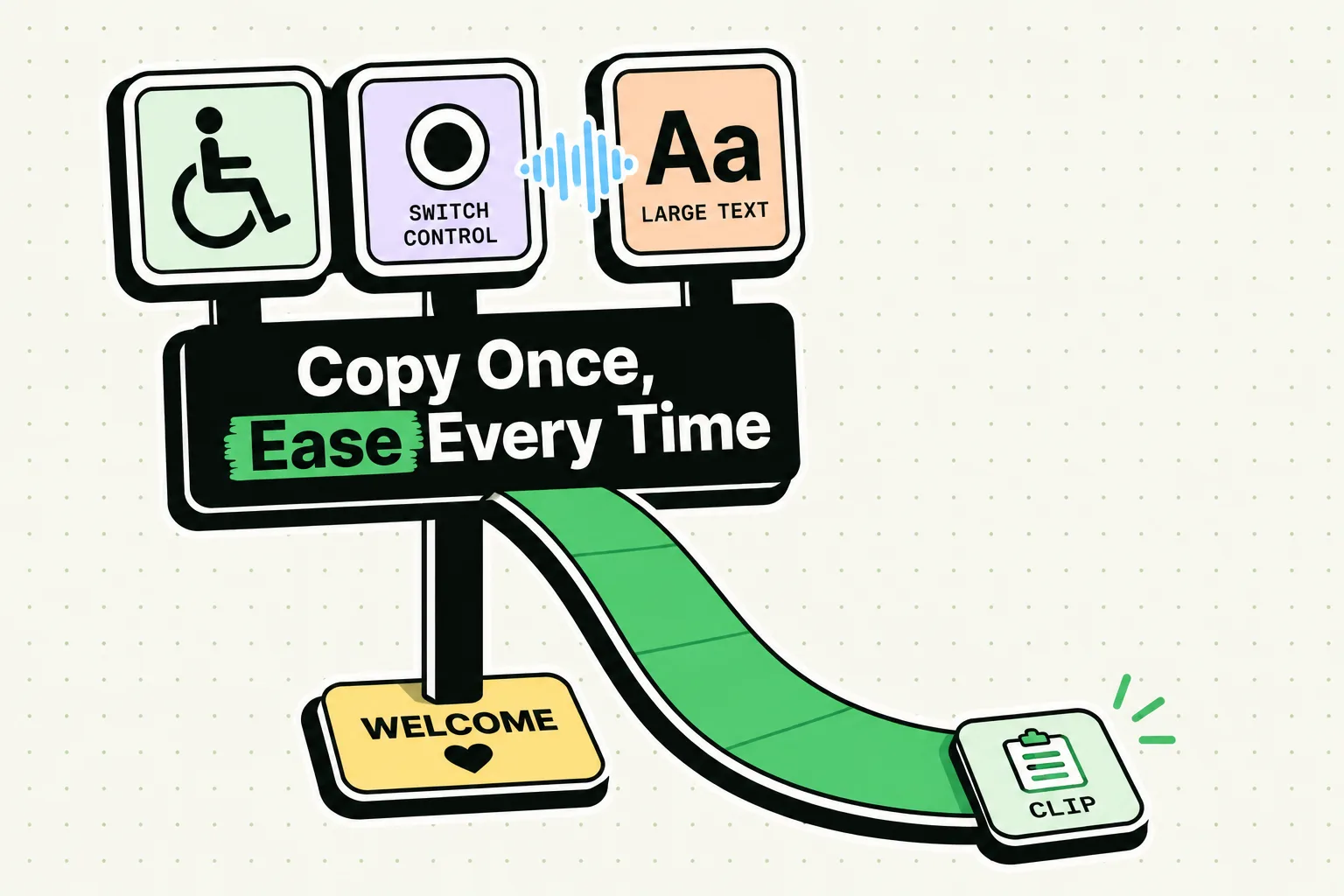
A single-item clipboard is a bigger problem for accessibility than it looks. Every time you need to reuse a piece of text, native iOS forces you back to the original source to select and copy it again, and text selection is one of the most physically and cognitively demanding interactions on a touchscreen. A clipboard manager reduces that repetition by saving what you copy once, so retrieval afterward is a tap instead of a full navigate-select-copy cycle. Here's specifically how that helps, and where it doesn't.
The Core Problem: Repetition Costs More for Some Users Than Others
Consider filling out three separate forms with the same home address, with no clipboard history:
- Navigate to the source (Messages, Contacts, Notes).
- Find and select the address text.
- Copy it.
- Navigate to Form 1, paste.
- Navigate back to the source, re-select, re-copy (since the clipboard was overwritten by something else in between, or just out of habit).
- Navigate to Form 2, paste. Repeat for Form 3.
That's a dozen-plus discrete interactions, several of which involve fine text selection, one of the hardest touchscreen gestures to perform precisely. With a saved, pinned copy of that address in a clipboard manager, the same task becomes: open the app, tap the saved address, navigate to the form, paste, repeat. The selection step disappears entirely after the first time.
For someone without a motor, visual, or cognitive disability, this is a mild convenience. For someone for whom each individual tap or selection gesture carries real physical or cognitive cost, cutting out the repeated selection step is a bigger deal than the word "convenience" suggests.
Motor Accessibility
For anyone using AssistiveTouch or Switch Control, every interaction (tap, swipe, dwell) is a deliberate, effortful action rather than an unconscious reflex. Precise text selection, dragging handles to the exact start and end of a phrase, is often the single hardest gesture in this category.
A pinned clip removes that gesture from the repeated part of the workflow. You still need to navigate to the clipboard manager and select the saved item, but that selection is a single tap on a list row, not a drag-handle text selection. If you rely on Switch Control specifically, fewer total switch activations to reuse the same piece of text is a meaningful, measurable reduction, even though this article isn't presenting formal timing data to quantify it.
Visual Accessibility and VoiceOver
VoiceOver reads screen elements aloud as you navigate by swipe. A list-based clipboard history gives VoiceOver something structured to read through: each saved clip as a discrete, announced row, rather than needing to visually scan a source app for the right piece of text.
Caveat worth stating plainly: accessibility support varies by app and by version, and no clipboard manager should be assumed to have complete, polished VoiceOver coverage across every screen without you testing it yourself first. ClipboardAI includes accessibility labeling on its core screens (clip list rows, search, primary buttons, keyboard extension), but if VoiceOver compatibility is a hard requirement for you, test the specific flow you depend on before building a workflow around it, the same advice that applies to any third-party app, not just this one.
Cognitive Accessibility
For people managing ADHD, memory changes, or executive function challenges, clipboard history works as a passive external memory: you don't have to decide in the moment to "save this for later," it's saved automatically because you copied it. That removes a decision point (should I write this down?) that itself costs cognitive effort.
It also shortens task-switching. Retrieving a previously copied item from a search or a pinned list is a smaller interruption than navigating back to an original source app, re-finding your place, and re-establishing context, all of which cost more for someone for whom task-switching itself is effortful.
For caregivers: if you're setting this up on behalf of someone else, pin the handful of things they're likely to need repeatedly (home address, an emergency contact number, a caregiver's number) rather than leaving it to build up unsorted. A big unsorted clipboard history is not automatically easier to use just because it's automatic.
Where This Actually Helps vs. Where It Doesn't
| Situation | Does clipboard history help? | Why |
|---|---|---|
| Repasting the same address/phone/email into multiple forms | Yes | Removes repeated text-selection gestures |
| Finding something you copied but forgot where from | Yes, if you're using search | Passive capture means it's saved even if you didn't plan ahead |
| Needing text you copied before installing the app | No | Clipboard managers can't retrieve what they never captured |
| A task that requires typing new text, not reusing existing text | No | Clipboard tools don't help with original composition |
| Full VoiceOver navigation of every screen in an unfamiliar app | Untested claim, verify yourself | Accessibility support varies by screen and isn't something to take on faith from marketing copy |
Setting It Up
- Install ClipboardAI from the App Store.
- Pin the handful of items you (or the person you're supporting) will need repeatedly: address, phone number, emergency contacts.
- If you use more than one Apple device, turn on iCloud sync in Settings so the same pinned items and history are available on both.
- Test with your actual accessibility settings on (VoiceOver, Switch Control, Dynamic Type, whatever you rely on) before assuming it fits your workflow, rather than assuming based on this article alone.
Honest Caveats
- This is not a substitute for iOS's own accessibility features. It works alongside VoiceOver, Switch Control, AssistiveTouch, and Voice Control; it doesn't replace or improve them.
- Accessibility labeling exists but is not exhaustively verified across every screen. Treat any specific claim about VoiceOver behavior as something to test in your own setup, not something to take as guaranteed.
- It cannot reduce the effort of the very first copy. The selection-and-copy action still has to happen once, the benefit is in not repeating it.
- iPhone, iPad, and Mac only. There's no ClipboardAI for Windows or Android, so this only helps within the Apple ecosystem.
Frequently Asked Questions
How does a clipboard manager help with iPhone accessibility?
By saving what you copy once, so retrieving it later is a single tap instead of repeating the navigate-select-copy sequence. This is most valuable for anyone who finds text selection or app navigation physically or cognitively costly.
Does ClipboardAI work with VoiceOver?
It includes accessibility labeling on core screens like the clip list, search, and primary buttons, but coverage should be verified in your own setup rather than assumed to be complete across every screen.
Can a clipboard manager help with memory difficulties?
Yes, it functions as passive external memory: everything you copy is saved automatically without requiring you to decide in advance to record it, which is useful for anyone who has difficulty recalling where they saw a piece of information.
Does this replace built-in iOS accessibility features?
No. It's a complementary tool that reduces repetitive text-selection tasks; it does not replace VoiceOver, Switch Control, AssistiveTouch, or Voice Control, and it depends on those features working normally underneath it.