
The Bottom Line
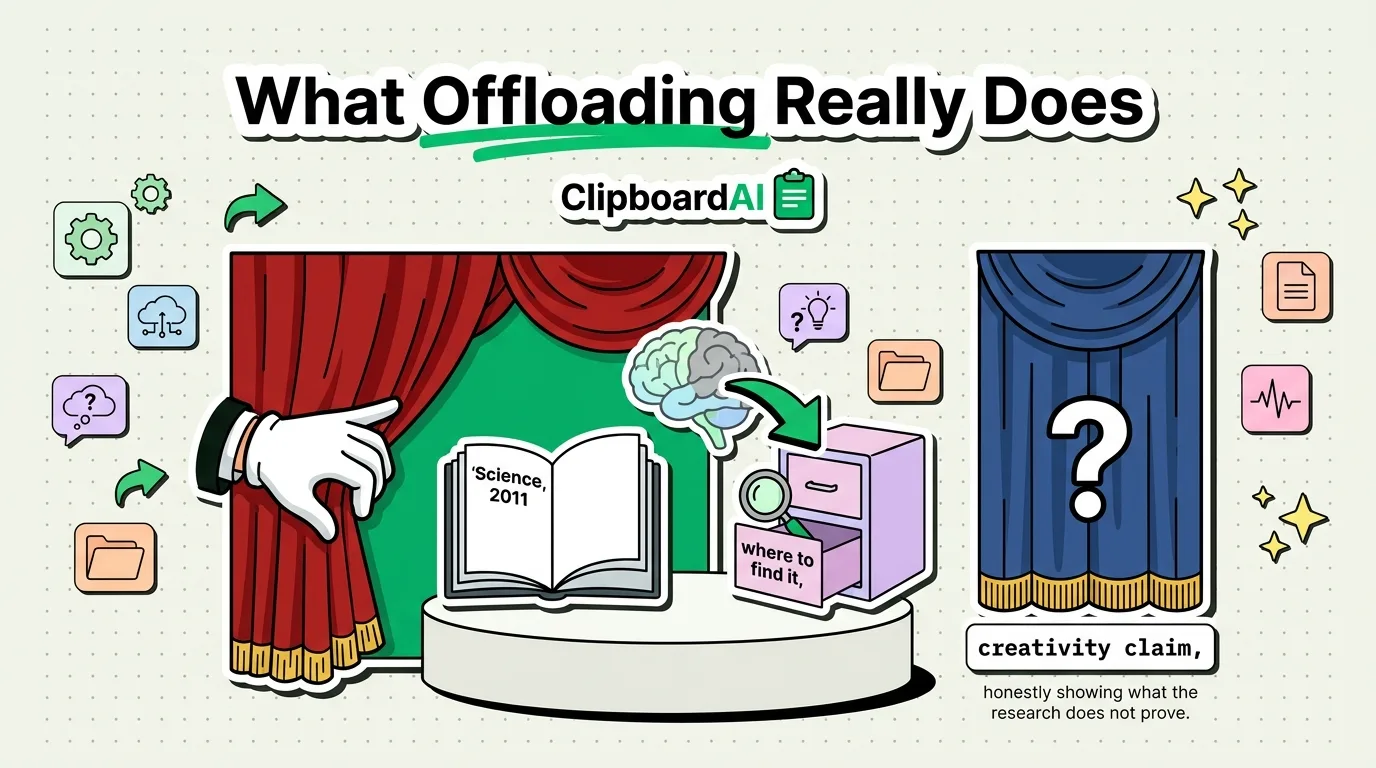
"Cognitive offloading" is a real, named area of psychology research: using physical or digital tools (notes, reminders, external memory aids) to reduce the mental burden of holding information in your head. The best-known study in this space is Sparrow, Liu, and Wegner's 2011 Science paper "Google Effects on Memory," which found that people were less likely to remember information itself when they expected to be able to look it up again, but more likely to remember where to find it. That's a specific, testable finding about search and recall, not a general claim about clipboards, creativity, or productivity, and this article won't stretch it further than what it actually shows.
What This Research Does and Doesn't Establish
| What's reasonably supported | What isn't |
|---|---|
| People shift what they remember when they know a fact is retrievable externally (the "Google effect" / transactive memory) | That copy-pasting specifically, as opposed to note-taking or search generally, has been studied as its own category |
| Offloading a memory task can free attention for a concurrent task in controlled lab settings (see Risko & Gilbert's 2016 review "Cognitive Offloading" in Trends in Cognitive Sciences) | That offloading reliably "boosts creativity" in everyday phone use; this specific causal claim isn't established by the above research |
| External memory aids are a long-studied, legitimate psychological topic, not a fringe idea | Any specific numeric claim like "X% more creative" or "X minutes saved," which isn't something this research measured |
Where This Actually Applies to a Clipboard Manager
The honest, defensible version of this idea: if you don't have to worry about losing something you copied (because a clipboard manager keeps history instead of overwriting it after one use), you spend less working memory holding onto "don't forget to paste this" and can focus on the actual task. That's a plausible extension of the offloading idea, not a proven effect of ClipboardAI specifically. We're not aware of any published study measuring clipboard managers themselves.
ClipboardAI keeps a running history so you can copy multiple things across a task and paste them all later, instead of the single-item default that forces you to paste immediately or lose what you copied. Whether that measurably improves creative output isn't something we can claim; what's true is that it removes a specific, real point of friction (the fear of overwriting something you needed).
A Direct Caveat
This article deliberately avoids the common pattern of citing "neuroscience" or "science shows" without naming a specific study. If you want to read the primary sources yourself: Sparrow, Liu & Wegner, "Google Effects on Memory" (Science, 2011), and Risko & Gilbert, "Cognitive Offloading" (Trends in Cognitive Sciences, 2016). Neither paper mentions clipboard managers, and no citation here should be read as an endorsement of ClipboardAI by the researchers.
Frequently Asked Questions
Is there a published study specifically on clipboard managers and memory?
Not that we're aware of. The connection drawn here is a reasonable extension of general cognitive offloading research, not a direct finding about clipboard tools.
Does relying on a clipboard manager make my memory worse?
The Sparrow et al. research suggests you may remember content less when you know it's retrievable, but remember where to find it better. Whether that's a net negative depends on what you value: recalling facts unaided, or freeing attention for other tasks. The research doesn't take a side on which is "better."