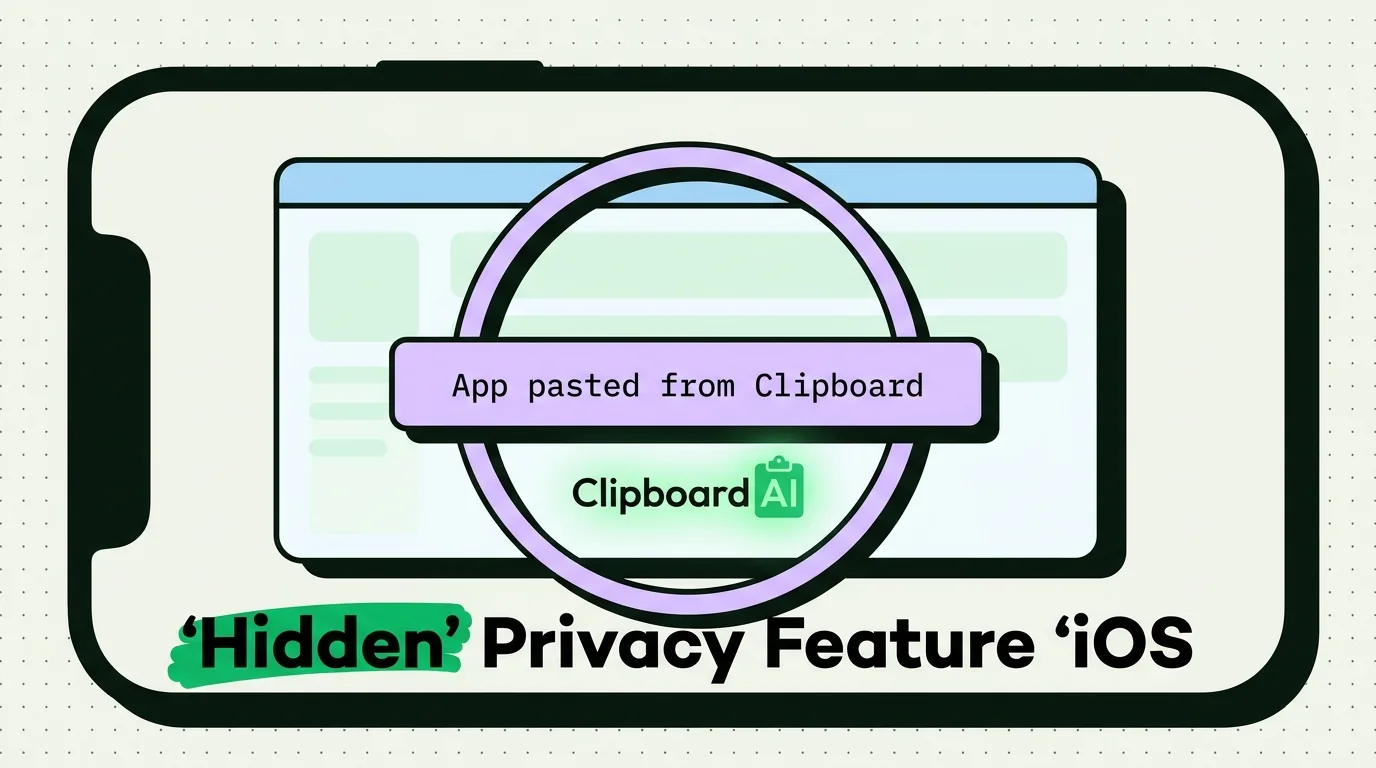
Since iOS 16, your iPhone has quietly required apps to ask permission before reading clipboard content that came from a different app. You've almost certainly seen the dialog, "[App] would like to paste from [Other App]", without registering what it actually does: it's a system-level gate that stops apps from silently reading whatever you last copied, including passwords, codes, and private messages. Here's exactly how it works, what it does and doesn't protect against, and how to get the most out of it.
What the Dialog Actually Does
Before this system existed, any app could read your clipboard the instant it came to the foreground, no notification, no consent. Copy a password, open an unrelated app, and that app could silently read it. That was the state of iOS clipboard privacy through iOS 13.
The paste permission system changes that. When an app you're currently using tries to read clipboard content that was written by a different app, iOS intercepts the read and shows a permission dialog with two choices: Allow or Don't Allow. If you decline, the requesting app gets nothing back, not an error, not a message, just an empty result, as if the clipboard were blank.
Same-App vs. Cross-App Reads
The permission check only fires for cross-app access. If you copy text inside an app and paste it within that same app, no prompt appears, the app already has legitimate access to its own data. The dialog is specifically for the scenario where App B tries to read something App A put on the clipboard.
Persistent Settings
You don't have to answer the dialog every time. Per-app settings (Allow / Ask / Deny) persist, so you can set your email client or notes app to Allow once and never be asked again, while setting apps you don't trust to Deny so they never even get to ask.
How It's Enforced
All clipboard reads on iOS go through the UIPasteboard API. When an app calls it to read clipboard content that originated elsewhere, iOS checks the app's stored permission setting:
- If set to Allow, the data is returned immediately.
- If set to Deny, the app receives nothing.
- If set to Ask (the default for apps you haven't configured), the dialog appears and the app is blocked until you respond.
This happens at the OS level, underneath any individual app's code, so an app cannot bypass, disable, or silently work around it on a standard, non-jailbroken device.
A Short, Accurate Timeline
| iOS version | What changed | What it does NOT do |
|---|---|---|
| iOS 1-13 | No clipboard protection at all | - |
| iOS 14 | Added a banner showing when an app reads your clipboard (transparency only) | Does not block access, only reveals it after the fact |
| iOS 16 | Added the Allow/Don't Allow permission prompt and persistent per-app settings (enforcement) | Does not give you clipboard history or let you see what was read |
| iOS 17-18 | Refined false-positive rate and dialog behavior | Still no clipboard history, search, or categorization |
The widely cited "2020 clipboard scanning" reporting (multiple apps found reading clipboard contents on every launch) is what pushed Apple toward the iOS 14 transparency banner; that reporting is well documented in contemporary tech press coverage from that period, though this article isn't attempting a full recap of it.
What This System Does Not Do
Being precise about limits matters more than being impressive here:
- It does not give you a clipboard history. It tells you that an app accessed the clipboard, not what was on it, and it does nothing to help you see or search past clips.
- It does not encrypt clipboard contents beyond standard device encryption. Clipboard data sits in RAM and is covered by the same device-level protection as everything else while the phone is locked; there's no separate clipboard-specific encryption layer.
- It does not protect you if you tap Allow reflexively. The dialog is only useful if you actually read it and decide, rather than dismissing it as a speed bump.
- It does not extend across devices automatically. If Universal Clipboard is enabled and your Mac or iPad has a less-trustworthy app installed, that device's clipboard access is a separate permission decision, not covered by an iPhone-side setting.
Getting the Most Out of It
- Actually read the dialog instead of tapping Allow automatically. Ask whether the requesting app has a real reason to read your clipboard right now.
- Set untrusted categories (games, casual social apps) to Deny in Settings > [App] > Paste from Other Apps, so they never get to ask.
- Set apps you paste into constantly (email, notes, messaging) to Allow to remove repeated friction.
- Use AutoFill instead of copy-paste for passwords wherever possible (Settings > Passwords > AutoFill Passwords), so passwords never sit on the clipboard in the first place.
- Pair this with a clipboard manager for visibility. The permission system tells you an app accessed your clipboard; it doesn't tell you what was on it at the time. A tool like ClipboardAI, which keeps its own local history, at least lets you check what you'd copied recently if a paste-access banner makes you suspicious.
Honest Caveats
- This is a native iOS feature, not something ClipboardAI adds or controls. ClipboardAI is subject to the same permission prompts as any other app when it reads clipboard content from elsewhere.
- Password-manager clipboard exclusion is a separate, Mac-only capability in ClipboardAI, not something the iOS paste-permission system provides. On Mac, ClipboardAI automatically recognizes the nspasteboard.org "transient/concealed" markers that apps like 1Password and KeePassXC already set, plus a manually curated Excluded Apps list. Nothing equivalent exists on iPhone or iPad; on iOS, rely on AutoFill instead of copying passwords manually.
- This system doesn't stop human error. If you paste a password into the wrong field, or leave it visible in a screenshot, the permission system has nothing to say about that.
Frequently Asked Questions
What is the "Allow Paste" dialog on my iPhone?
It's the paste permission system, introduced in iOS 16. It appears when an app tries to read clipboard content that a different app copied, giving you the choice to allow or block that specific read.
Do I need to turn this on?
No, it's on by default starting with iOS 16 and requires no setup. You can customize per-app behavior in Settings if you want to reduce how often you're asked.
Does this mean my clipboard is now encrypted?
No. It controls which apps can read clipboard data, not how that data is stored. Clipboard contents are protected by standard device encryption, the same as other data on a locked iPhone, not by anything specific to this permission system.
Can a clipboard manager see around this permission system?
No. Any app, including ClipboardAI, is subject to the same cross-app paste permission rules as every other app on the device.